On November 2, 2026, BDC launched Mission AI and AI Studio, two entrepreneur-led initiatives, under a release headline that says almost everything: less hype, more results. The numbers that come with it are sober. According to BDC’s survey, 69% of Canadian SMEs are “AI Novices,” 83% are still in the learning phase, and only 5% are AI Leaders with AI deeply integrated into operations and decision-making. In the same release, BDC notes that SMEs using generative AI are 24% more productive than those that don’t, yet only 30% of them use it.
What stands out is a line from Dominic Gagnon, who will lead Mission AI: an entrepreneur should not have to become an AI expert to benefit from it. A quote ready for review in minutes instead of hours. A sales follow-up before the opportunity goes cold. A first agent answering routine questions and booking appointments after hours. That is informed productivity: you know what you are automating, why, and what it returns. And that is exactly where most organizations stay stuck, between curiosity and proof. We are moving at a geometric rate in design: execution and operations are getting cheap, but education is expensive. That is the whole gap between having access to the tools and knowing how to use them.
A cone to find your bearings
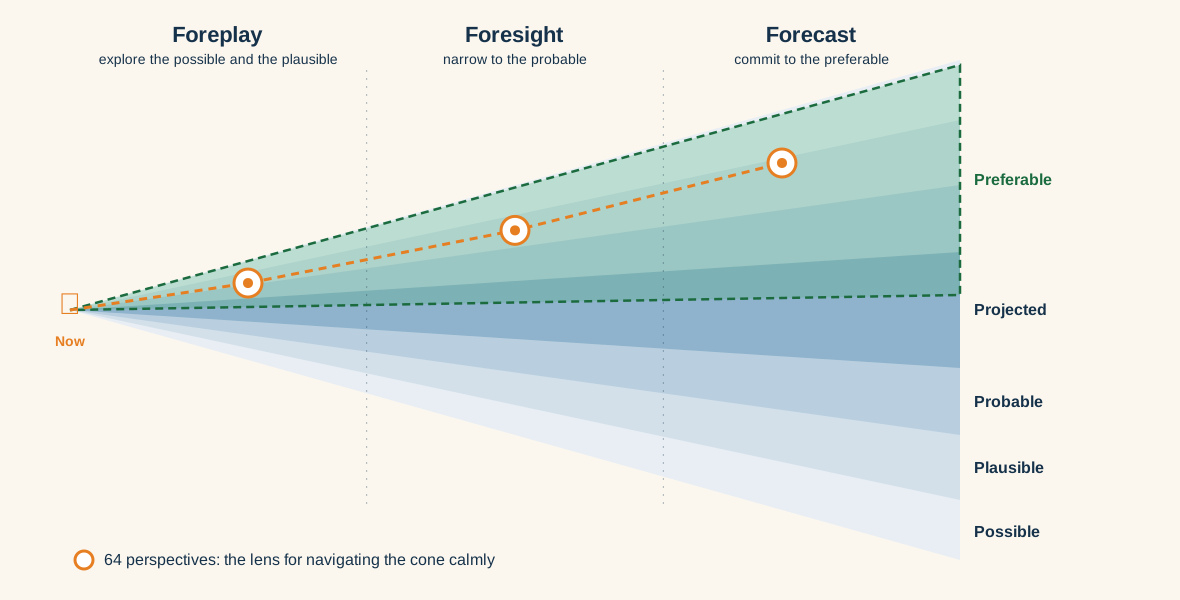
The Voros cone is a classic way of thinking about the future. From today, the future widens in nested layers. At the center, the projected: what happens if nothing changes. Around it, the probable, then the plausible, then the possible, the widest. The preferable is not measured by likelihood: it is what we choose, according to our values, from everything that is possible. The cone is not for guessing the future. It is for deciding where we want to go, knowing where we start from.
On this cone, the three horizons of the Learning Organization Framework (Calm Magic) find their place. Foreplay explores the whole cone, the possible and the plausible. Foresight narrows to the probable: it designs the architecture that gets you there. Forecast commits to the preferable and measures what actually happens. The sixty-four perspectives are not a stage: they are the lens that lets you navigate the cone without panic.
Read the transcript
Opening
A small snag. An alert that arrives too early. The future knocks before it even has a name.
Calm Magic, by Jonathan Belisle: a framework for preferable futures, in the agentic era.
To find your bearings: the Voros cone. It starts from today, and widens toward the future.
At the centre, the probable. Wider, the possible. And at the top, the preferable: the one we choose.
The roadmap places each agentic activity inside it: one zone, one month.
Example: a three-month residency. Month one, Foreplay. Month two, Foresight. Month three, Forecast.
Foreplay
Foreplay: exploring the possible. GL!TCH names the friction — a signal, not an error.
DRIFT follows the patterns that are alive.
TUNE chooses a direction, and sums it up in a proverb.
Foresight
Foresight: understanding what is emerging. LOVE builds trust and repair — nervous-system work.
MAGIC turns imagination into a practical tool: you build a world, one sense at a time.
Forecast
Forecast: realizing the future that matters. CALM designs the system,
OPEN connects it to real work,
FREE runs it with ease: you keep readjusting.
Closing
In the end, the framework dissolves into practice. The destination is not a point on the map: it is the quality of the movement.
Calm Magic. Paracosm.
Drag: technical debt falls, and with it the share of emotional debt that comes from basic needs (reliability, clarity, safety).
Ring of tolerance
Rotate the ring (buttons, ← → arrow keys or the legend chips) to reveal the comfort zone of each horizon.
Tap a target to see its trajectory and its debts.
Rings of tolerance. Each ring marks how far a target can drift from its trajectory before the organization feels it.
Whatever its trajectory, every target carries its own emotional debt, not only a technical one. But by starting with technical debt, you first cover basic emotional needs; what remains is the part that truly belongs to the target.
| Target | Zone | Technical debt | Emotional debt |
|---|---|---|---|
| Quote in minutes | Probable | 70 % | 65 % |
| Sales follow-up | Plausible | 55 % | 65 % |
| After-hours agent | Preferable | 35 % | 45 % |
| Agent governance | Possible | 80 % | 90 % |
| Team training | Plausible | 45 % | 80 % |
Illustrative example: replace these targets and levels with your organization’s.
Where we start: four stages
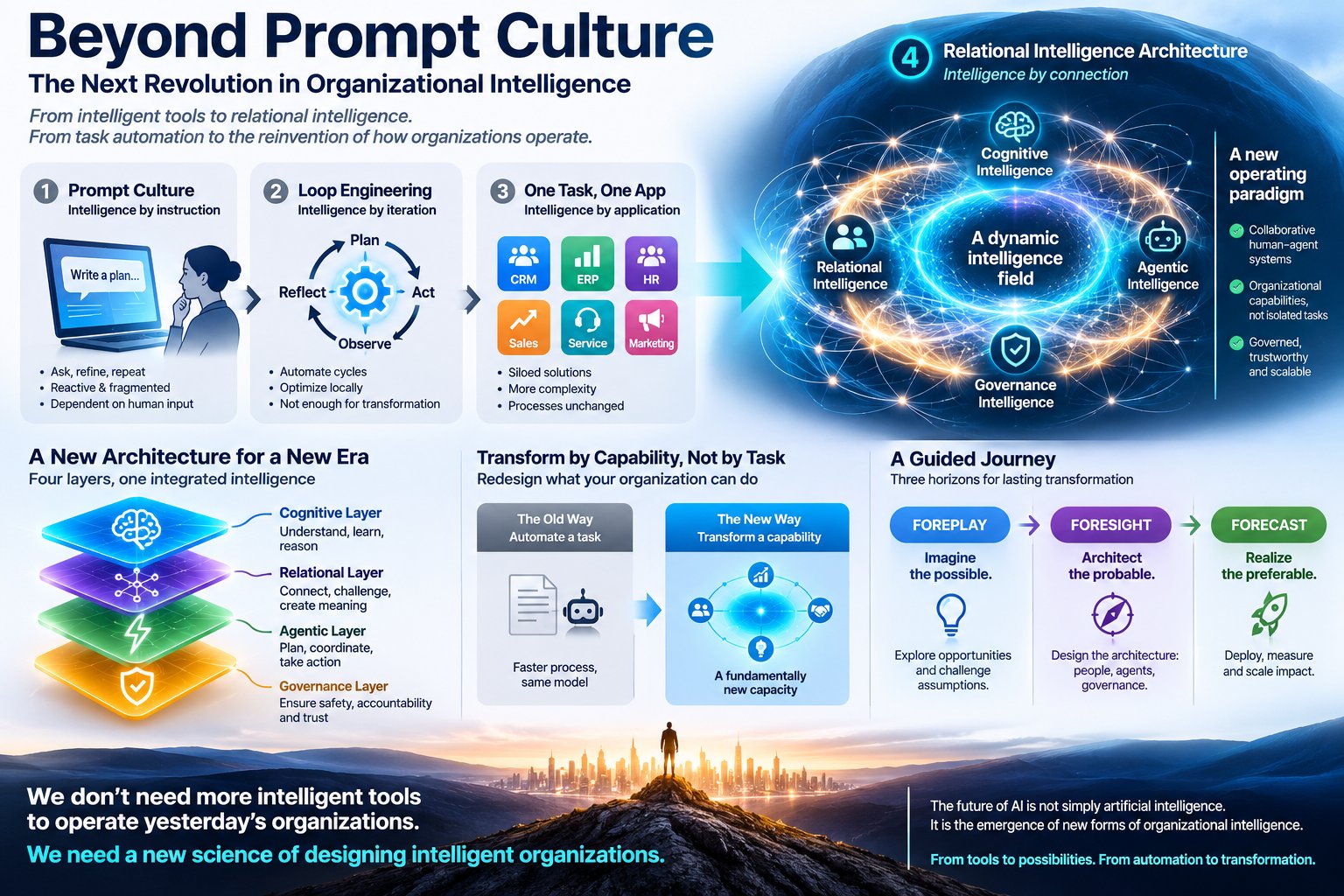
Before entering the cone, you need to know where you stand. The situation can be described in four stages. First, prompt culture: you ask, refine, repeat, and everything depends on the person at the screen. Then loop engineering: you automate cycles of planning, acting and observing, but locally, and that is not enough to transform anything. Next, “one task, one app”: one tool for the CRM, one for HR, one for marketing, siloed solutions, more complexity, processes unchanged. Finally, what the Beyond Prompt Culture diagram calls a relational intelligence architecture, a dynamic intelligence field where cognitive, relational, agentic and governance intelligence meet. Moving from the first three stages to the fourth is not a software upgrade. It is a change of question: from “which task do we automate?” to “which capability do we want to have?”
Foreplay: exploring the whole cone
Foreplay is imagining the possible: exploring opportunities and challenging assumptions before the stakes are real. It is the stage most often skipped, because it looks like play, when it is the only moment you can still change your mind cheaply. On the cone, it is the widest part: not everything is probable, but nothing is ruled out yet. Here the sixty-four perspectives widen. They keep a team from imagining only what the tool of the moment can already do.
Foresight: narrowing to the probable
Foresight is architecting the probable: designing people, agents and governance. Who decides what? Who supervises what? Where does the human stay in the loop, and why? On the cone, we leave the vast possible to look at what is really plausible in this particular organization. The perspectives then act as a test: governance that looks solid from above may prove fragile to the person who has to apply it on Monday morning.
Forecast: committing to the preferable
Forecast is realizing the preferable: deploying, measuring and scaling impact, with evidence rather than impressions. It is the discipline BDC asks of its own projects: solutions tested in real businesses, with measurable results. Here the perspectives nuance measurement: a time saving that only shows on a dashboard is not the same as one the team recognizes as its own. That is informed productivity: not only numbers, but numbers read from enough places to be trusted.
Sixty-four perspectives to navigate calmly
Between these three horizons, something is still missing if the decision is to be calm rather than merely fast. The sixty-four perspectives of the Learning Organization Framework (Calm Magic) are the concrete form of it: the Calm Magic Board, an 8 × 8 grid of tiles. Each tile comes from the crossing of two trigrams: a disposition in the row (Mindsets, Agilities, Goals, Landscape, Energy, Synergies, Methodology, Architecture) and an expression in the column (Chances Taken, Heart, Observer, Reversal, Design, Seeds, Protocols, Systems). “Open Possibility,” for example, is where Mindsets meet Chances Taken. The tiles fall into five families that echo the five axes of the compass: Pollens (Love), Noems (Magic), Poems (Calm), Totems (Open) and Anthems (Free). The practice is simple: one tile a day, with a single question of inquiry, a question to sit inside of rather than answer quickly. Before deciding, you sit with the question of the day. Calm comes from having looked at the decision from an angle you would not have chosen yourself.
Relational magic: everything ripples
An organization does not need smarter tools to run like yesterday. It needs to learn to decide differently, together.
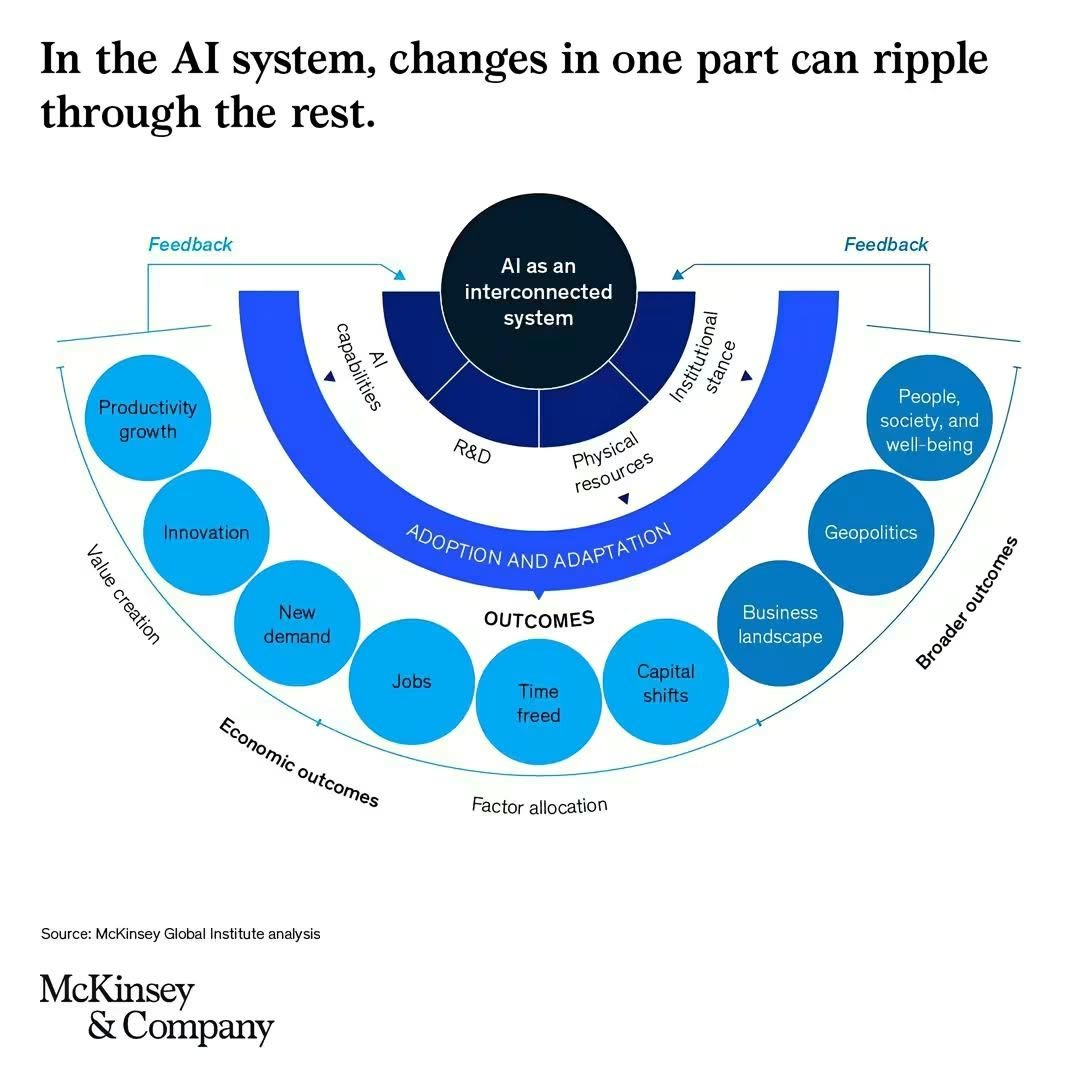
What remains is relational magic, and it is not decoration. A system where AI agents and humans coexist runs on trust: trust that the agent does what we think it does, that the manager hears the quiet objection, that the team can say “this isn’t working” without it being read as resistance. The McKinsey Global Institute presents AI as an interconnected system in which a change in one part ripples through the rest: capabilities, R&D, physical resources and institutional stance feed adoption and adaptation, which in turn produce economic outcomes (productivity growth, innovation, new demand, jobs, time freed, capital shifts) and broader outcomes (business landscape, geopolitics, people, society and well-being), with feedback loops. The “time freed” by an automation does not stay quietly in one corner of the chart: it shows up in the load on teams, in decisions made faster, in trust granted or withdrawn.
The organizations that move forward are not those with the most tools but those where someone took the time to build that trust and make it a practice. BDC’s release says it in its own way: entrepreneurs, not visiting experts, will test the tools and decide what works. Legitimacy comes from the field.
Where to start
The way in is modest. Pick a single process that costs you time, such as preparing a quote or following up on sales opportunities. Spend a half-day in Foreplay with the people who actually live it, imagining several ways to rethink it. Then draw the architecture: who supervises, who validates, where the human stays decisive. Then build a prototype, measure what it changes, and look at the result from more than one perspective before deciding to extend it. At the end you will not simply have one more tool. You will have a capability, and a team that knows how it got there.
For the same demand for structure seen from the tooling side, read AI in the organization: why piling up tools slows real productivity.
Sources and references
- BDC, launch release for Mission AI and AI Studio (November 2, 2026)
- McKinsey Global Institute, “The AI economy: Interconnected forces, feedback loops, and speeds of change” (AI system infographic)
- Calm Magic Board: the 64 tiles
- “Beyond Prompt Culture” infographic, holonomic map, Voros cone and video: Calm Magic · Paracosm