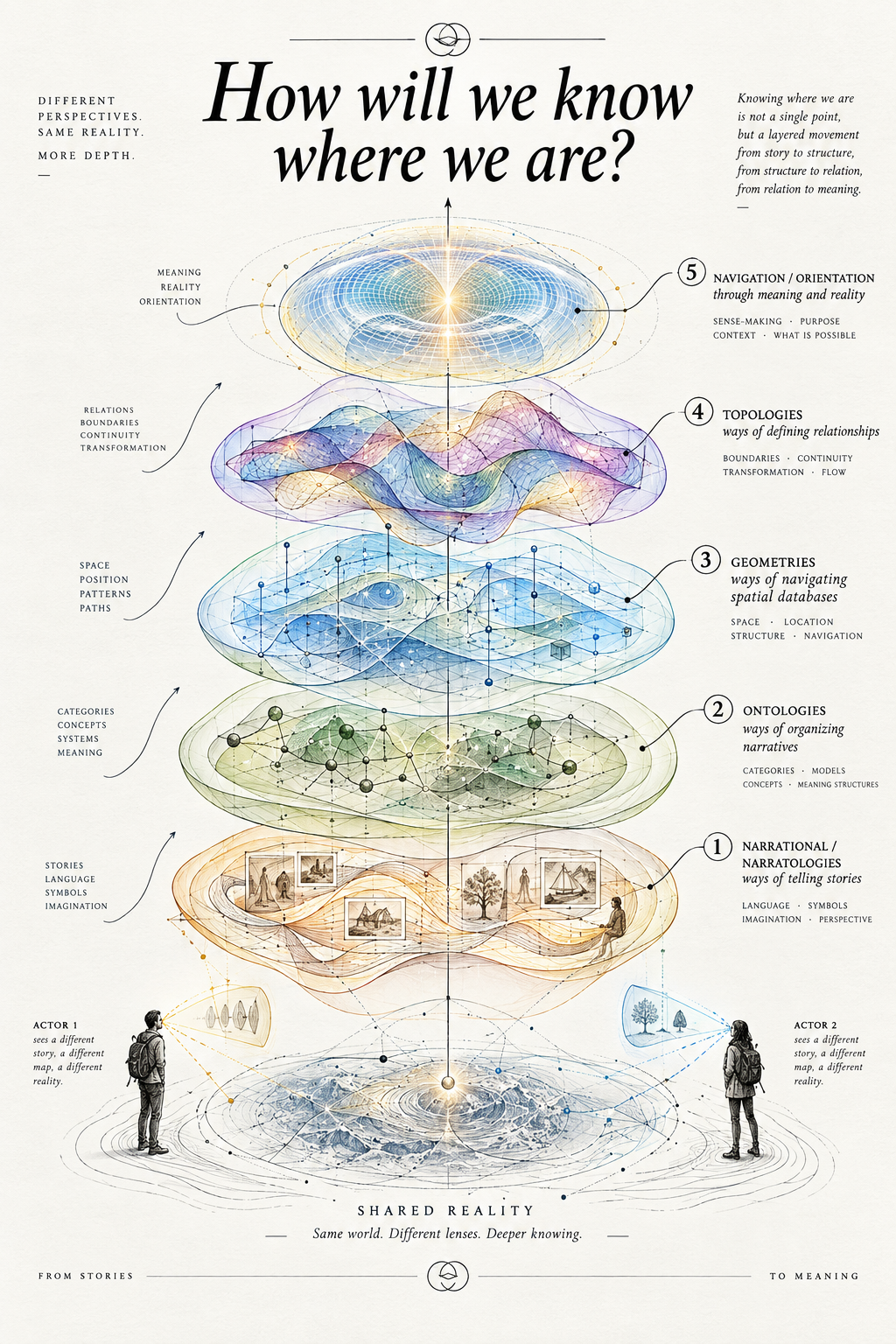
Ask a team where they are and you'll usually get a single point back: a quarter number, a milestone, a dot on a roadmap. That's not wrong, exactly — it's just incomplete in a specific way. A point tells you a position. It doesn't tell you how you got there, what's moving underneath it, or which direction has room to go. Knowing where you are has never really been a coordinate. It's a layered movement — from story, to structure, to relation, to meaning — and the real question isn't just where, but how you navigate what's possible from here.
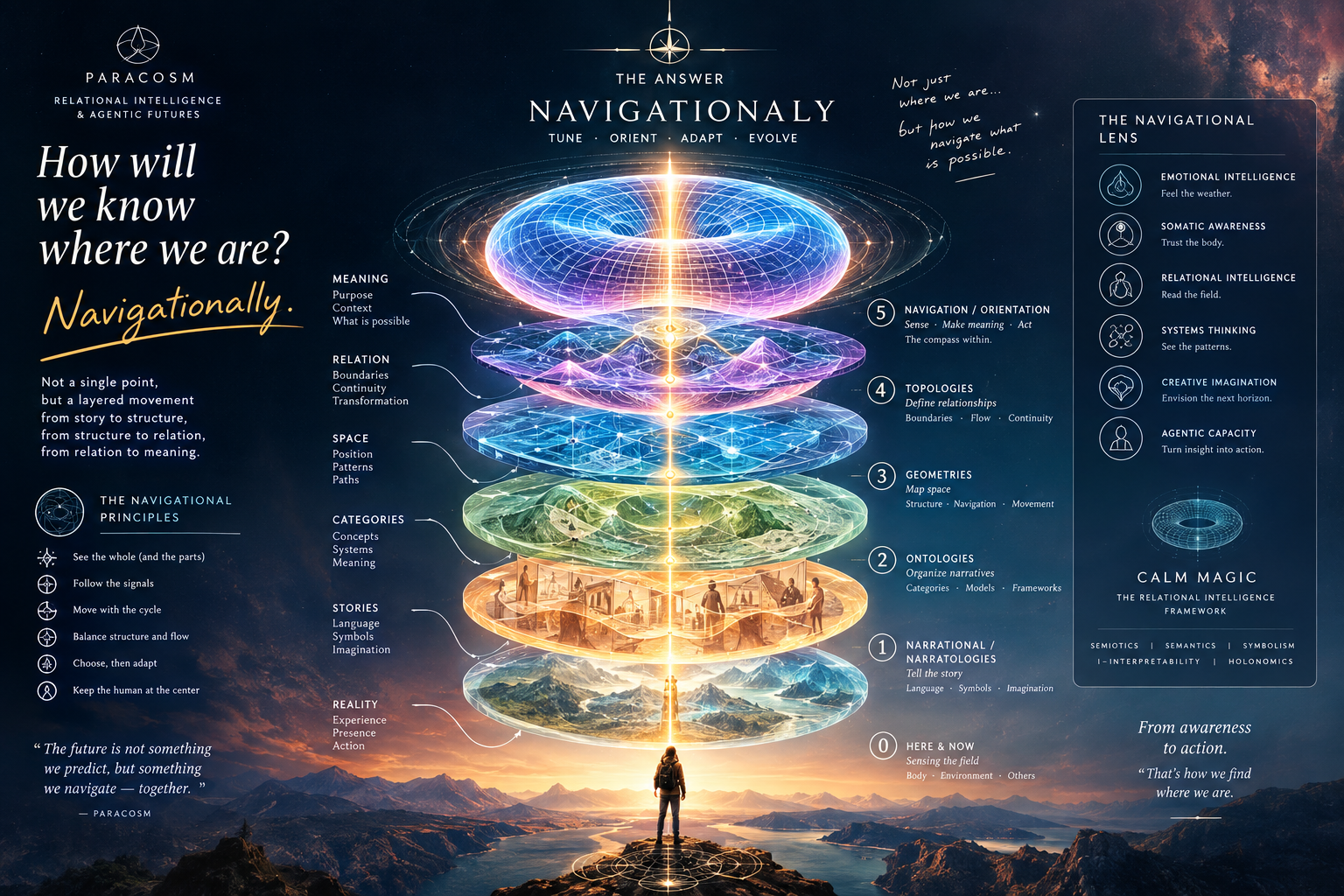
The lower layers of that movement are the ones most teams skip past without noticing. Here & Now is the base layer — sensing the actual field you're standing in: your body, the room, the people in it, before any of it gets narrated. Above that sits the Narratological layer, where sensing becomes story — the language, symbols, and imagination a group reaches for to describe what it just felt. Above that, Ontologies take those stories and organize them into categories, models, and frameworks sturdy enough to build a plan on. Most strategy work starts here, at the ontology layer, borrowing a framework before anyone's checked whether the sensing and the story underneath it were even accurate.
The upper layers are where orientation actually happens. Geometries map the space a model describes — position, pattern, the paths and movement available inside it. Topologies go a layer further, defining not positions but relationships: the boundaries, flows, continuities, and transformations connecting one part of the system to another, which is usually the layer that explains why a change in one place quietly breaks something three steps away. And at the top sits Navigation and Orientation itself — not a map at all, but the sense-making capacity that reads purpose and context against everything below it to ask what's actually possible from here. Paracosm calls that the compass within: the layer that turns six kinds of information into one next move.
None of those six layers reads itself. That takes practice, which is where the Navigational Principles come in: see the whole and the parts, not one at the expense of the other. Follow the signals instead of the plan when the two disagree. Move with the cycle rather than fighting its timing. Balance structure and flow — enough frame to act, enough looseness to adapt. Choose, then adapt the choice, rather than waiting for certainty that isn't coming. And through all of it, keep the human at the center, because every layer above Here & Now is still, eventually, read by a person.
Reading well across six layers takes more than a framework — it takes a trained set of capacities, which is what Paracosm calls the Navigational Lens: Emotional Intelligence, to feel the weather in a room before anyone names it. Somatic Awareness, to trust what the body already knows. Relational Intelligence, to read the field between people, not just the people themselves. Systems Thinking, to see the patterns a single data point can't show. Creative Imagination, to picture the next horizon before it's provable. And Agentic Capacity, to turn an insight into an actual next move instead of a better description of the problem. This is the same lens underneath Calm Magic's Relational Intelligence Framework — semiotics, semantics, symbolism, i-interpretability, and holonomics — applied here to the specific question of orientation.
The future is not something we predict, but something we navigate — together.
Here's the part worth sitting with: two people standing in the same room, looking at the same shared reality, are almost never reading the same map. One sees the story; the other sees the structure. One's tracking relationships; the other's tracking position. Neither is wrong — they're reading different layers of the same system, and most of the friction that gets called disagreement is actually just two honest readings talking past each other. The work isn't picking whose map is correct. It's building the shared practice of moving between layers together, which is the actual throughline connecting this to Foreplay, Foresight, and Forecast: explore the story, understand the structure, build the next move, and keep checking all six layers as the ground shifts under you. The future is not something we predict, but something we navigate — together.